
 u.today
We cannot just ignore the structural shift revealed by XRP’s on-chain and market behavior over the past month. With the start of ETF trading for XRP, the asset is transitioning into a new liquidity regime, in which abrupt increases in exchange activity are the new norm rather than an anomaly. Price structure, market depth and network metrics are already showing this shift.
XRP's shift continues
The payment-count data, which is in the upper end of its recent one-month range, consistently demonstrates high throughput. Despite price weakness, XRP continues to process nearly a million transactions daily, indicating stable underlying demand.
Payment volume, a much more erratic indicator, has shown regular significant spikes, particularly on Nov. 14, as well as late November and early December. These spikes, which frequently coincide with times of higher exchange volume, are indicative of spikes in high-value transfers.
Waiting for XRP's confirmation
This is significant because institutional desks and automated arbitrageurs are a completely new class of liquidity participants introduced by ETF trading. Instead of slow organic trends, their activity tends to produce abrupt, erratic exchange flows. Exchange liquidity spikes are therefore becoming a reality for XRP, and investors should anticipate that these spikes will distort conventional metrics more frequently in the future.
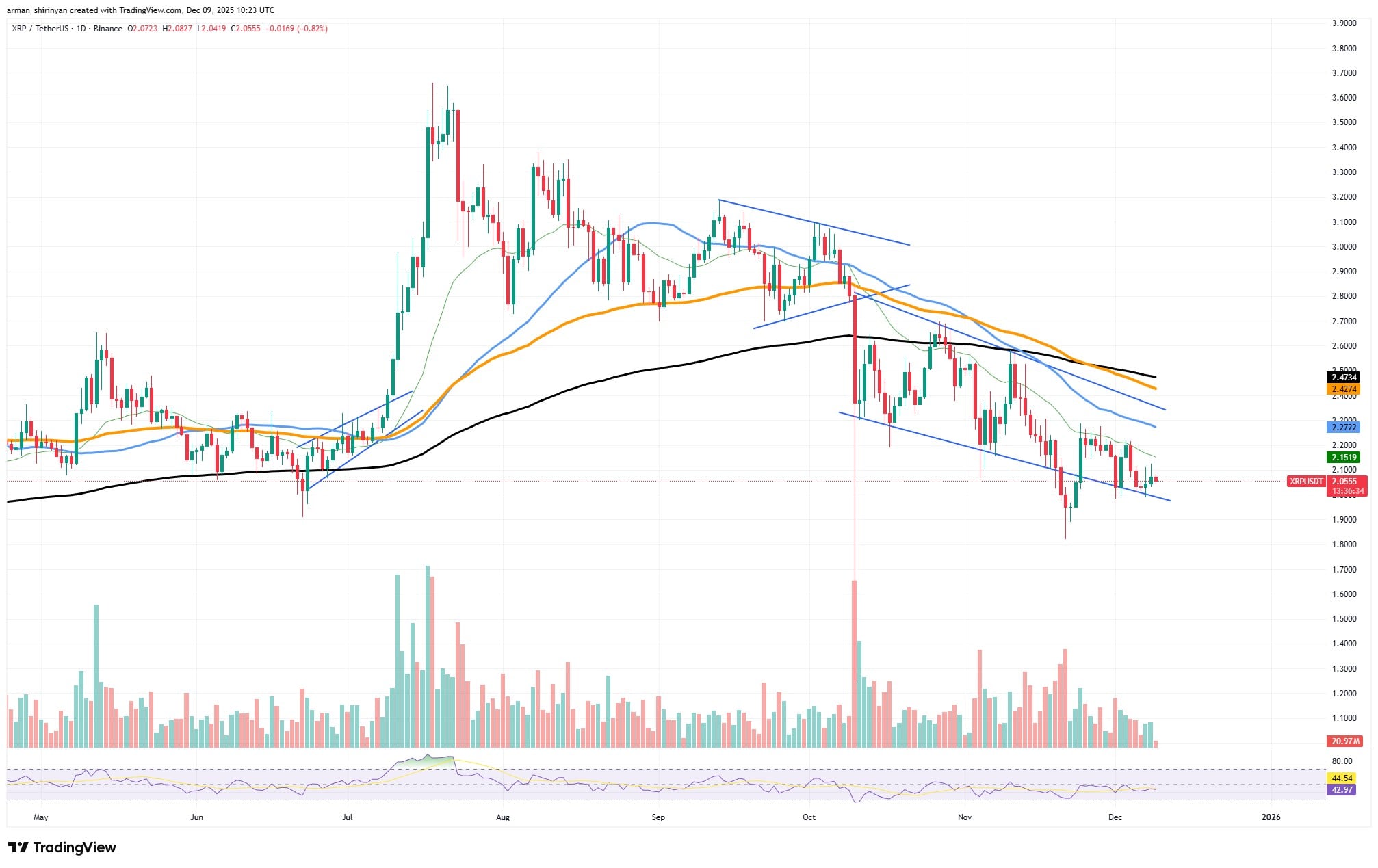
XRP is still trapped in its declining channel in terms of price. Long-term structure is still dominated by sellers, but the channel’s lower boundary holds, indicating a weakening of bearish pressure. The market’s wait-and-see attitude is highlighted by the RSI staying flat in the mid-40s, indicating neither oversold nor overbought conditions. The notion that the price is coiling for an increase in volatility is supported by the overall downward trend in volume.
When combined, these indicators suggest that the market is getting ready for more significant liquidity shocks as ETF volumes rise. ETF arbitrage, rebalancing or custodial movement are common causes of spikes in exchange holdings or payments, which should no longer be automatically interpreted as accumulation or distribution.