


 1
1


 19
19
One of the most ridiculous exchange outflow prints the market has seen in months was just recorded by Shiba Inu: 33.25 trillion SHIB left exchanges in a single 24-hour period. That type of transfer would, theoretically, suggest whale consolidation, massive accumulation or even a coordinated supply shock.
Supply-driven or natural?
However, the price and volume charts paint a different, much more realistic picture: this was most likely an anomalous spike rather than the start of a supply-driven meltdown.
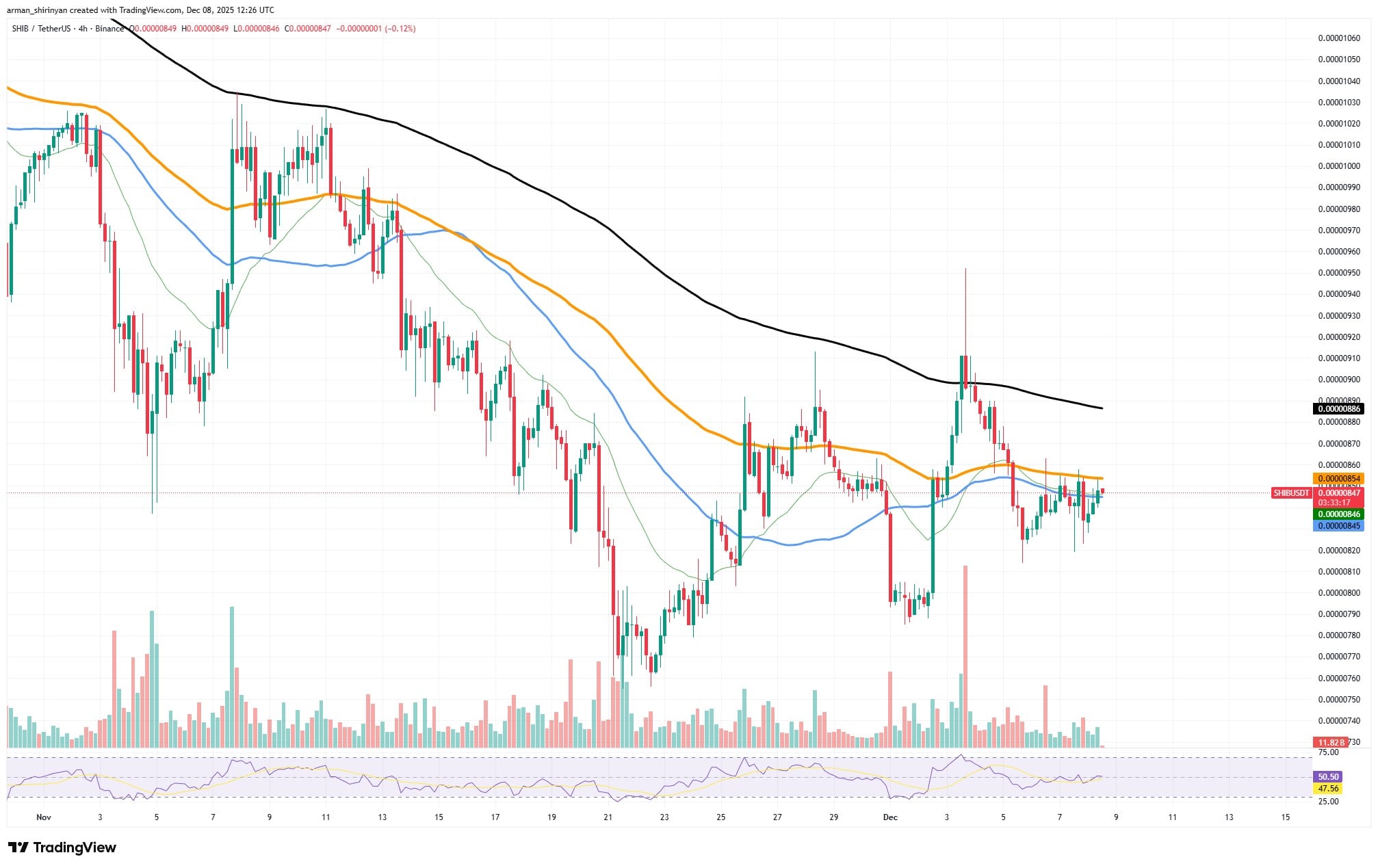
SHIB is trading in the vicinity of $0.0000084-$0.0000086, nearly exactly where it was prior to the reported outflow. There is not a sudden squeeze on liquidity, a breakout or an increase in buying pressure. The market typically responds when trillions of tokens lawfully depart exchanges for whale wallets or cold storage: spreads widen, volume increases and price momentum quickens. None of that occurred here.
Shiba Inu stays down
This disconnect is validated by the volume profile. There is no corresponding spike in trading volume on the four-hour and daily charts that would support, or indicate, actual accumulation of this magnitude. Rather, despite brief stabilization, SHIB is consolidating under major moving averages (50-, 100- and 200-period), and is obviously still stuck in a longer-term downtrend.
Investors are left with two reasonable interpretations of this: an anomaly in tracking or reporting, which frequently occurs when on-chain analytics incorrectly aggregate large wallet cluster movements; or misclassified, user-driven outflows. Iinternal exchange rearranging is also very prevalent in SHIB’s dispersed liquidity environment.
The lesson for SHIB holders is straightforward: the 33 trillion print should not be interpreted as a secret whale signal. The asset still lacks the volume required for a clear trend reversal, is still building a base and is still having trouble regaining moving averages. Nothing on the charts indicates that this outflow event served as the catalyst for a recovery, even though the market structure is improving.

 coindesk.com

 thecryptobasic.com

 news.bitcoin.com