


 4
4
- Polygon permanently removed 100 million $POL tokens with an estimated valuation of $10.12 million.
- The liquidated volume equates to approximately 1% of the asset’s total issued supply.
- The transaction utilized funds accumulated within the network’s fee-collector contract, which held nearly 121 million $POL.
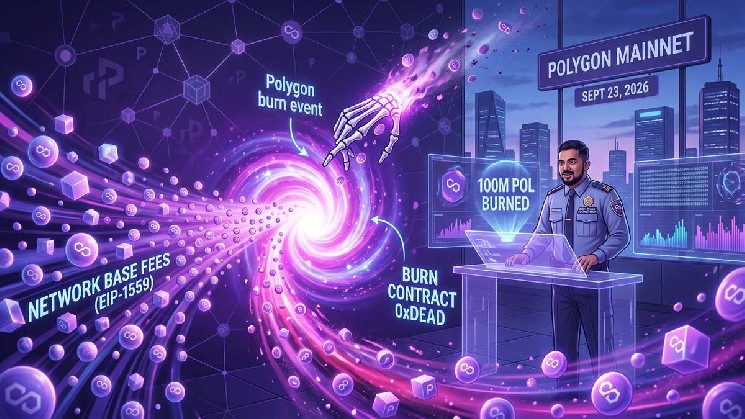
Polygon burned 100M $POL tokens this Wednesday via a direct transaction on its blockchain. The Executive Director of the Polygon Foundation, Sandeep Nailwal, confirmed the execution in a post on his X account.
BURN COMPLETE: 100 MILLION $POL (~1% of $POL total supply) IS OFFICIALLY BURNED PERMANENTLY.https://t.co/3MOAw9eD8o pic.twitter.com/incm4389Df
— Sandeep | CEO, Polygon Foundation (※,※) (@sandeepnailwal) September 23, 2026
The transfer originated from an address marked with the contractual suffix «0xDEAD» and was routed to the core $POL token contract. Through this technical procedure, the assets were rendered entirely irrecoverable for any future secondary market circulation.
The source of the funds did not involve the foundation’s operational budget or institutional treasury reserves. Instead, the capital stemmed from the steady accumulation of gas generated by network users over recent months.
According to a technical report from crypto exchange KuCoin, processing fees on Polygon split into two specific components upon transaction validation: a priority fee and a mandatory base fee.
Validators responsible for block production receive priority fees as an incentive for their computational work. Conversely, base fees are automatically redirected to a collector smart contract designed to aggregate network surpluses.
Prior to this operation, the collection module held approximately 121 million units of $POL. With the transaction executed on September 23, 2026, the system consumed the vast majority of that accumulated reserve.

Technical mechanics of the EIP-1559 framework and community execution
Polygon’s technical infrastructure has operated under a model similar to the EIP-1559 improvement proposal since January 2022. Official protocol documentation notes that this mechanism aims to establish a direct, predictable correlation between actual network activity and the systematic reduction of tokens in circulation.
The key innovation within this deployment lies in the functional decentralization of future burns. Contract parameters allow any community participant to trigger the burn function once contract balances reach protocol-approved thresholds.
Under this framework, supply reductions are expected to occur on a roughly quarterly cadence. According to details shared by Polygon developers, the actual pace of these burns will depend strictly on the volume of transactions paying base fees across the ecosystem.
The secondary market did not immediately reflect the supply contraction. As of 7:34 a.m. UTC on September 23, 2026, the $POL token traded at $0.1014 following a 6.46% decline over a 24-hour window, according to data from CoinMarketCap.
Over the seven-day period preceding the transaction, the asset maintained a 10% gain. Total market capitalization stood at $1.07 billion, while 24-hour trading volume surged 77% to reach $228.83 million on the day.
Market commentary suggests that price absorption following supply reduction events tends to unfold gradually due to broader market liquidity dynamics.
The next evaluation cycle for automated $POL token burns will depend on the balance reported by the network’s collector contract at the close of the fourth quarter of 2026.

 coindesk.com
 coinfomania.com
