


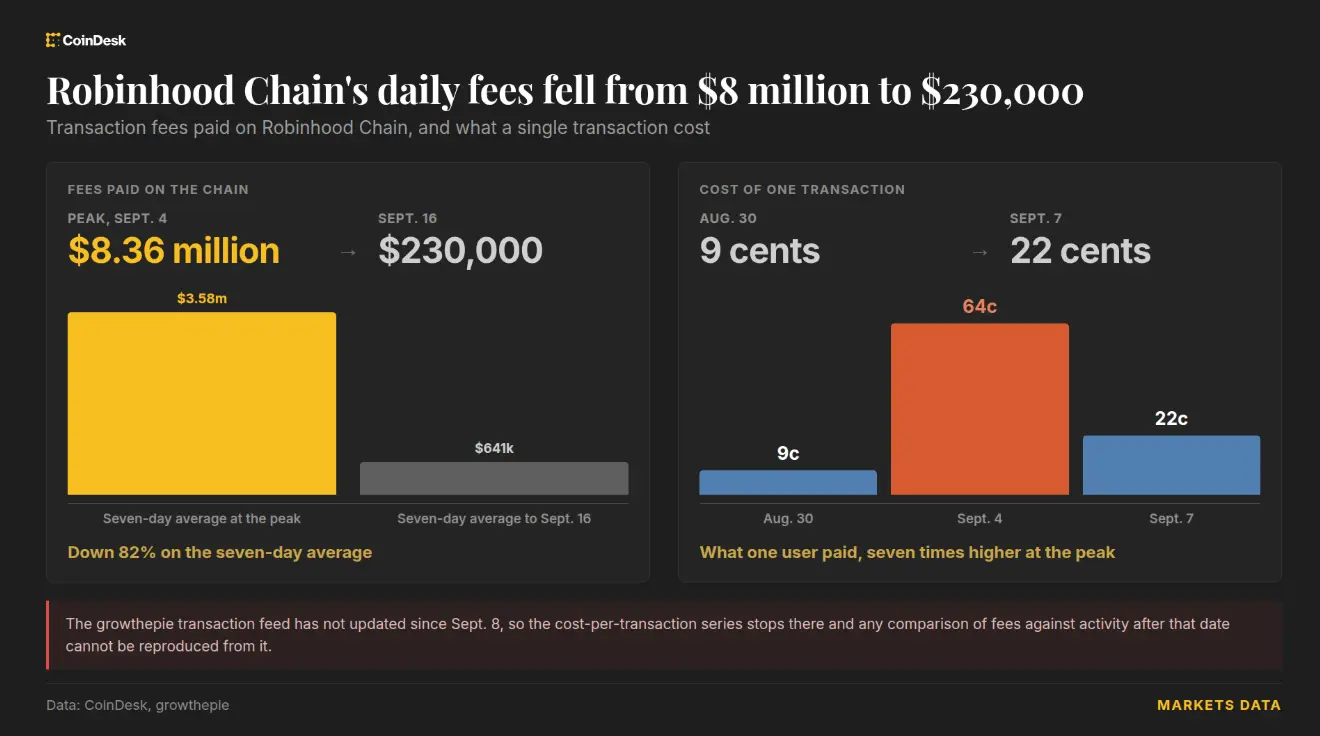
The memecoin rush that made Robinhood Chain one of the most expensive networks has cooled, taking 97% of the network's fee income with it, even as transaction counts held near their highs.
That marks a sharp turn from Aug. 30, when applications on the two-month-old chain earned $2.7 million in a day, twice as much as those on Ethereum and behind only Solana. Token issuance platform Pons and memecoin trading app GMGN supplied about $2 million of that total as users launched 22,600 tokens in 24 hours.
Read More: Robinhood Chain beats Ethereum in daily revenue as memecoin trading takes over
At its peak in early September, the chain collected roughly $8 million in fees from 13.1 million transactions in a single day, averaging 64 cents a transaction. However, by Sept. 16, the daily bill had fallen to about $230,000 across 8.9 million transactions, or just 2.6 cents each, according to growthepie data.
The money paid to use the chain fell 97%, while activity on it fell 32%, a gap that only opens when a network gets cheaper rather than emptier.
The collapsing fee chart invited an explanation that higher costs may have chased traders back to Solana and taken Robinhood’s volume with them. Weekly data, however, shows a narrower retreat.
Robinhood's decentralized exchanges handled about $13 billion in the seven days through Sept. 16, up 5% from the preceding week, according to CoinDesk calculations using DeFiLlama, while stablecoin supply slipped just 1% to around $1 billion, with about $930 million of that sitting in decentralized-finance applications.
The businesses built on the chain kept earning far more than the chain itself, taking about $8 million in fees over the latest 24 hours and retaining $1.5 million as revenue per data tracked by DeFiLlama, against the network's $230,000.
What traders are saying
Pseudonymous trader Unipcs, who is ranked first by all-time profit on FOMO, a trading platform that tracks memecoin traders' performance publicly, held his positions through the reversal and said the expensive stretch never entered his thinking.
"The earlier higher gas fees did not affect me or any trencher I know," he told CoinDesk in a Telegram message. "People don't care about that as long as they can make money on the chain.” Trencher, in crypto parlance, is someone who trades newly launched tokens in the earliest hours after they appear, when prices move fastest.

-
1Why Wall Street giants build tokenization money for institutions, not regular consumers
-
2CFTC sends crypto rules to White House to review as Congress stalls on Clarity Act
-
3Crypto tech provider Haruko hit by cyberattack affecting 15 clients, some funds lost
-
4DHS’s predictive policing is unconstitutional, un-American and should be stopped
-
5ECB President Christine Lagarde intervened to block Binance’s EU MiCA license: WSJ
-
6Zcash targets November upgrade to make private payments up to three times faster
-
7XRP on the brink of a golden cross as focus switches to altcoins
-
8Layer-2 and DeFi tokens lead broad crypto advance as post-Fed hike nerves fade
-
9Bitcoin weathers September storm as rate hikes and Clarity act setback test bulls
-
10Live updates: Bitcoin climbs over $80,000 as crypto shakes off Clarity failure and higher interest rates

The Definitive Stablecoin Landscape Series: Asia Pacific

The Definitive Stablecoin Landscape Series: Asia Pacific
As stablecoins move into regulated finance, APAC is becoming a key proving ground. This report maps the region’s rules, use cases, and $RLUSD’s role.
As stablecoins move into regulated finance, APAC is becoming a key proving ground. This report maps the region’s rules, use cases, and $RLUSD’s role.
Why it matters:
As stablecoins move into regulated finance, APAC is becoming a key proving ground. This report maps the region’s rules, use cases, and $RLUSD’s role.

Why Wall Street giants build tokenization money for institutions, not regular consumers

Crypto tech provider Haruko hit by cyberattack affecting 15 clients, some funds lost


 crypto-economy.com
 coinfomania.com

 cryptoslate.com

 thedefiant.io
