
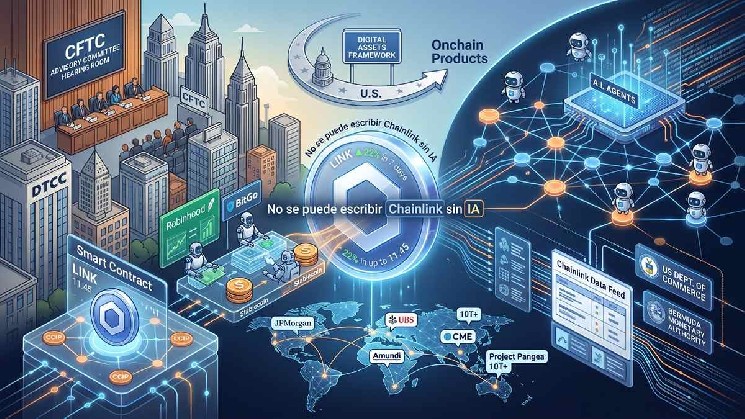

- Chainlink’s native asset (LINK) posted a 22.05% gain over the past week, reaching $11.45 at the close of trading.
- The “Chainlink for Agents” platform launched in mid-August to facilitate autonomous payments for artificial intelligence systems.
- Project representatives presented a smart contract architecture before the CFTC designed to safeguard financial markets against algorithmic manipulation.
Over the past seven days, Chainlink rallied 22%. This significant upward move coincides with the firm’s operational expansion into the autonomous agent sector and a stronger presence in regulatory discussions across the United States.
The token’s price climbed to reach $11.45 at the close of the week. TradingView data reveals that the price action stems from a convergence of technological and strategic factors. Chris Barrett, Communications Director at the company, described this milestone as an essential integration of their services under the motto “You can’t spell Chainlink without AI.”
You can’t spell Chainlink without AI https://t.co/f07sI9M1Cx
— Chris Barrett (@ChrisBarrett) August 21, 2026
The Ecosystem for the Agent Economy
In mid-August, the firm unveiled “Chainlink for Agents,” a platform built to serve as a verified data layer for artificial intelligence agents. Official documentation indicates that the core objective is to resolve the limitations of traditional banking systems, which operate on restricted schedules and slow processing times ill-suited for systems requiring continuous execution.

The infrastructure leverages the Cross-Chain Interoperability Protocol (CCIP) to enable agents to execute transactions using stablecoins. Report data highlights that firms such as Robinhood and BitGo have already begun integrating this layer, confirming a tangible commercial demand for instant settlement solutions.
Simultaneously, the company’s strategy is gaining momentum in the regulatory arena. During recent hearings before a CFTC advisory committee, Chainlink co-founder Sergey Nazarov outlined how smart contract architecture can serve as a defense mechanism. The proposal advocates leveraging this technology to shield financial markets against potential exploits or manipulation driven by advanced AI systems.
This approach appears to align with a recent shift in the stance of U.S. authorities. According to insights shared by Chris Barrett, the current debate in Washington has moved from questioning the legitimacy of digital assets toward establishing regulatory frameworks to migrate financial products into onchain environments.
The traditional financial sector has also reinforced its engagement with the protocol. Several institutions—including the Project Pangea banking consortium managing over $10 trillion in assets, the DTCC clearing corporation, and firms like UBS, Amundi, JPMorgan, and CME—already utilize Chainlink solutions for real-world asset settlement.
The network continues to serve as a critical data bridge, delivering macroeconomic indicators from the U.S. Department of Commerce and integrated supervision tools for entities like the Bermuda Monetary Authority. Institutional demand for these technical capabilities stands out as the primary driver behind recent capital inflows.
The company’s next phase will focus on deepening these commercial partnerships and standardizing its role within the national financial infrastructure, keeping the rollout of its new platform at the core of its adoption strategy over the coming months.

 coinedition.com
 cryptoslate.com

 crypto.news
 bitcoinworld.co.in