


Grayscale’s new SEC filing for a Worldcoin ETF reveals that just 100 wallets hold approximately 90% of all circulating $WLD — a concerning level of centralization for co-founder Sam Altman’s “coin for the world.”
These numbers contrast with the token’s whitepaper, which outlined a simple goal tied to eyeball-scanning orbs and token giveaways around the globe: “The majority of $WLD tokens will be claimed by individuals simply for being verified unique humans.”
It would be bad enough if that were Worldcoin’s only decentralization failure.
Unfortunately, the filing also acknowledges the project’s dependence on a centralized sequencer, upgrade functionaries, bridge operators, and governance that rarely uses its own so-called governance token.
One of the aforementioned $WLD wallets is 0x470458C91978D2d929704489Ad730DC3E3001113, the bridge between Ethereum and World Chain, and likely represents multiple users.
Grayscale discloses Worldcoin’s actual tokenomics
The admissions come not from critics but from Grayscale, a sponsor that wants to bundle up $WLD tokens into a Nasdaq-listed ETF and sell shares to retail investors.
Grayscale filed its S-1 application for its ETF on July 20, proposing to list on the Nasdaq under the ticker symbol GWLD.
Its risk factors state plainly, “As of the date of this filing, the largest 100 $WLD wallets held approximately 90% of the $WLD in circulation.”
Worldcoin and OpenAI co-founder Sam Altman posted in October 2021 that Worldcoin “will be distributed fairly to as many people as possible.”
The project’s whitepaper forecasted, “The majority of humans alive today will claim $WLD tokens, which may result in $WLD becoming the most widely distributed digital currency.”
The word “may” is doing a lot of heavy lifting there.
Grayscale’s lawyers had to tally actual, rater than aspirational, numbers. Their disclaimers warn that it’s “possible, and in fact, reasonably likely, that a small group of early $WLD adopters may hold a significant proportion of the $WLD that’s been released to date.”
That sums it up. Altman’s coin overwhelmingly went to the 1%.
World Network’s $WLD down 98% amid Altman–Musk legal battle
Worldcoin, the non-governing governance token
$WLD is nominally a governance token, but it hasn’t been particularly useful.
According to the filing, $WLD “in the future may be used to participate in governance of the World Network.” Mechanisms for that future transition are “novel and untested at scale.”
For now, the filing admits, governance “remains substantially guided by the World Foundation.”
All of these legal disclaimers are certainly distinct from Worldcoin’s initial marketing materials.
In December 2023, the project boasted, “Worldcoin has a superpower for governance with its proof-of-personhood.
“This allows implementing one-person-one-vote democracies, something not previously possible.”
One person, one vote, maybe someday
The idea of one person, one vote works when each person has only one vote. This is certainly not the case with $WLD’s ownership distribution.
Also, it would be helpful if community votes actually occurred.
Indeed, its 2024 whitepaper promised, “The $WLD token, alongside World ID, will be used for protocol governance.”
Yet, according to Grayscale’s filing, governance votes have been mostly non-existent. “As of the date of this prospectus, governance of the World Network remains substantially guided by the World Foundation, which has stated its intention to progressively decentralize governance over time,” it says.
In other words, as it stands, governance isn’t decentralized.
Grayscale acknowledges Worldcoin’s centralization
Grayscale’s filing this week also discloses the project’s dependance on one blockchain sequencer.
“World Chain’s sequencer is operated on a centralized basis, and World Chain remains at an early stage of decentralization relative to the Ethereum network.”
Upgrade functions, the filing notes, sit under “coordinated control by a limited number of participants” tied to the World Foundation, the Worldcoin-supporting Tools for Humanity, and Optimism, the operator of the Ethereum layer 2 on which Worldcoin’s smart contracts rely.
Unveiling World Chain in April 2024, Worldcoin declared, “For World Chain to succeed it must be built, owned and governed by all of humanity.”
All of humanity, in reality, is nowhere close to governing Worldcoin.
As recently as May 2025, the foundation promised, “Our transition to full decentralization follows a precise roadmap. By late 2026, we expect to reach the final stages.”
It’s currently July 2026, and it’s not on track to achieving that deadline.
Finally, Worldcoin’s iris-scanning Orb completes the pattern of centralization today while talking about decentralization in the future tense.
Grayscale concedes that as of today, Worldcoin’s “Orb is manufactured and distributed principally by or under the direction of Tools for Humanity, and the World Foundation exercises significant influence over the protocol, the $WLD treasury and ecosystem grants.”
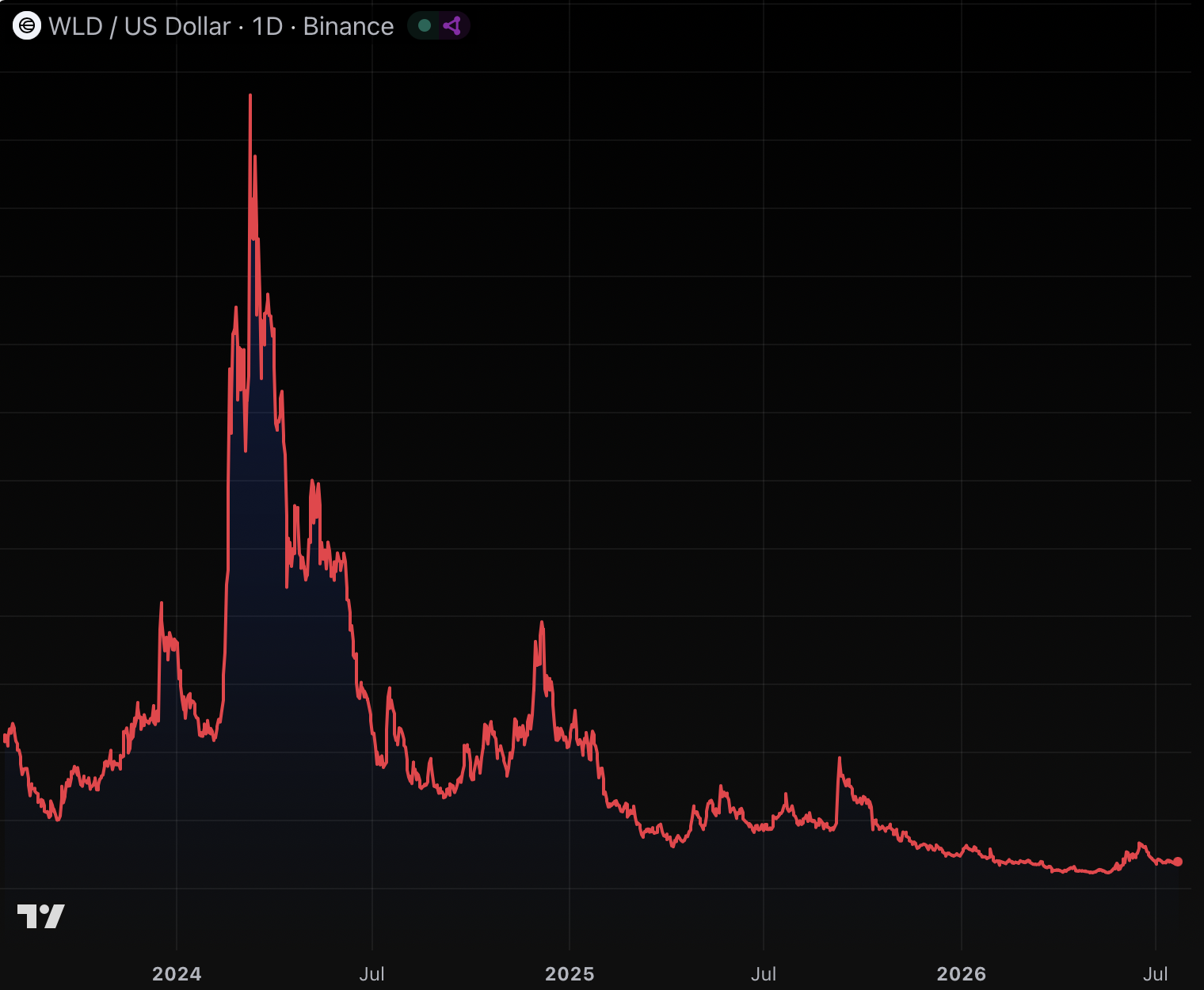
$WLD was trading near $0.40 as of publication time, 20% lower year-to-date and 96% below its March 2024 peak of $11.74.
Protos reached out to World for comment but received no reply prior to publication.

 ambcrypto.com
 bsc.news


 en.cryptonomist.ch
 bitcoinworld.co.in