



 8
8
Ripple is pushing to add a lending layer to the $XRP Ledger, the blockchain behind $XRP, in a bid to let institutions borrow against assets they hold onchain rather than just issue and move them.
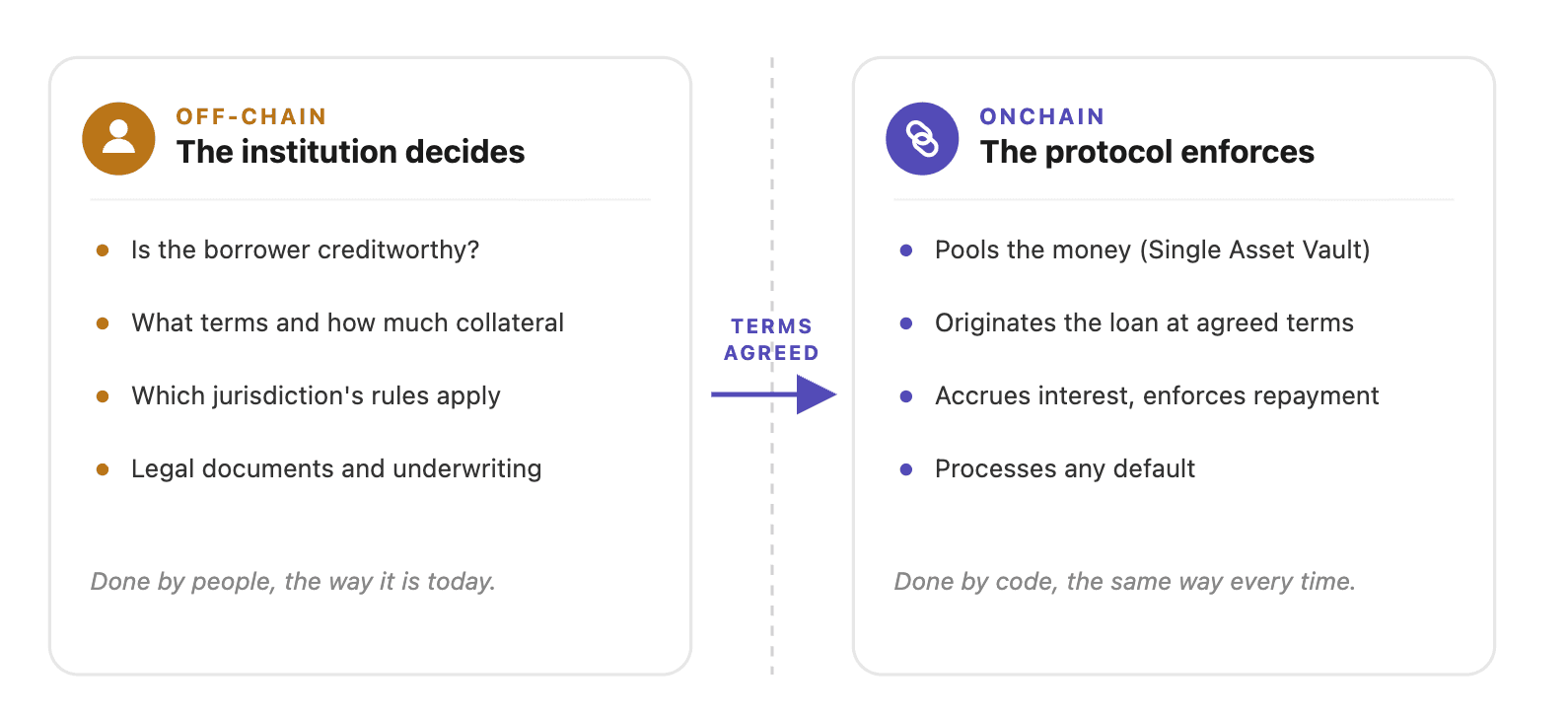
The proposed XRPL Lending Protocol, a copy of which was shared with CoinDesk, is built on a simple split. The blockchain handles the mechanics of a loan once it is agreed, how money is pooled, how interest adds up, how repayment is enforced and how a default is processed, while the actual credit decision, whether a borrower is good for the money and on what terms, stays with the lending institution off the blockchain.
Its pitch is that a blockchain is good at enforcing rules consistently but cannot judge creditworthiness or navigate the rules that differ by jurisdiction, so that judgment should stay with the people who do it now.
The protocol has two parts. A Single Asset Vault pools a single asset, and the lending layer turns that pooled money into loans with set terms. Both are still proposals, defined in technical drafts known as XLS-65 and XLS-66, and remain subject to approval by the validators who run the network. The features are available to test on a development network but are not live.
The use Ripple leads with is short-term financing. A payment company holding reserves in $RLUSD, its US dollar-pegged stablecoin, might need cash to fund outgoing payments before a cross-border settlement clears two days later.
Instead of drawing on a bank credit line or selling assets, it could borrow against the incoming settlement through an approved pool, with repayment enforced automatically.
This is separate from $XRP, the token the network is best known for, and from $RLUSD, which is one of the assets such a system could lend against. It is infrastructure aimed at institutions rather than a product retail users would touch directly.
Ripple is also walking into a crowded field, however. Onchain lending already runs at scale through protocols like Aave, Compound, Maple and Clearpool, which collectively hold billions in deposits.
However, Ripple says that those systems were built around crypto-native governance, where a protocol can change its risk rules through community votes, which it says institutions cannot underwrite in advance. Its counter is to fix the lending mechanics at the network's base layer so the behavior does not shift underneath a lender, while keeping the network public rather than walling it off to a closed group as some permissioned systems do.

 cryptopolitan.com
 bitcoinworld.co.in


 crypto.news
 coingape.com
 1
1