

 2
2
Tether Shuts Down Alloy Platform and Gives Users 3 Months to Recover Gold Collateral
Tether will begin winding down Alloy by Tether and aUSDT, its overcollateralized digital asset backed by Tether Gold, as the company shifts attention to products with stronger demand and deeper liquidity.
The decision follows an internal review of user activity, market appetite, and Tether’s broader strategic priorities. Alloy launched in 2024 as an open platform for creating digital assets backed by Tether Gold tokens (XAUT). Its flagship product, aUSDT, was designed as a dollar-pegged token overcollateralized with tokenized gold.
An official statement by Tether said the platform provided “valuable insights into demand for gold-backed digital assets, collateralized products, and the ways users interact with tokenized real-world assets.”
Still, the company now plans to concentrate resources on XAUT and other core products across its ecosystem.
New Minting Ends as Wind-Down Begins
The wind-down will take place in stages. Starting immediately, the Alloy by Tether interface will no longer allow users to open new positions or mint new aUSDT. Tether said the move is intended to stop new exposure from being created while giving existing users a clear path to exit.
Current users will have three months to return their aUSDT and withdraw the XAUT collateral tied to their positions, subject to the platform’s terms of use. After Sept. 17, 2026, customers who have not returned their aUSDT will no longer be able to recover their XAUT through the Alloy platform.
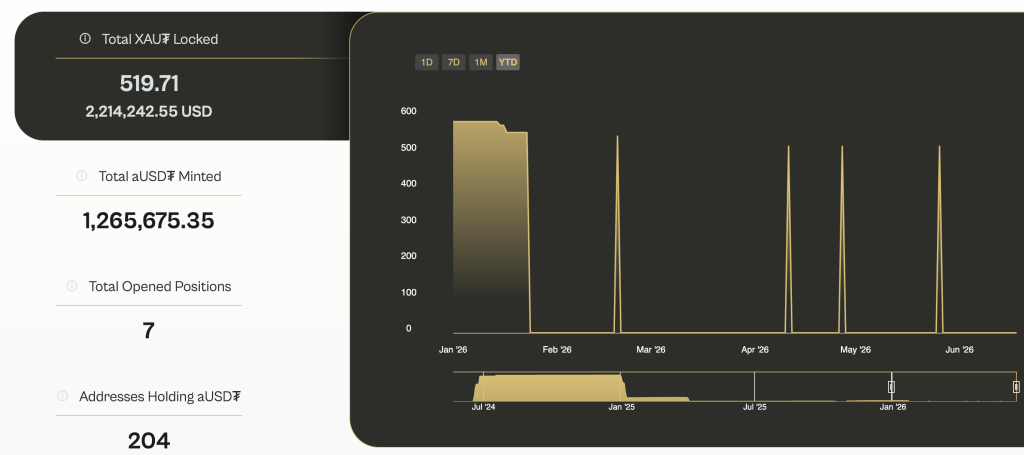
The platform’s website shows aUSDT with a market capitalization of about $1.27 million. It is backed by 14.73 kilograms of gold valued at roughly $2.2 million.
Tether Refocuses on Core Stablecoin and Gold Products
The closure does not signal a retreat from tokenized real-world assets. Instead, it shows Tether refining where it wants to allocate capital, engineering resources, and market attention.
Gold-backed digital assets remain part of that strategy through XAUT, which Tether is keeping as a core product. The company has also continued to explore new stablecoin markets.
In May, Tether said it plans to launch GELT, a stablecoin representing the Georgian lari, with support from the Georgian government.
For Tether, the Alloy wind-down is a reminder that not every tokenized asset structure finds enough market depth to justify long-term support. The company is keeping the broader thesis intact, but narrowing its focus to products where liquidity, user demand and strategic opportunity appear stronger.

 cointelegraph.com
 blockchainreporter.net

 en.cryptonomist.ch