


 23
23
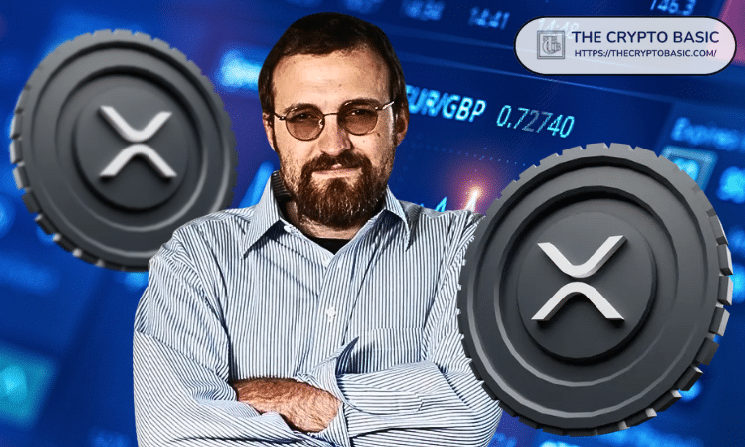
Charles Hoskinson, the Cardano founder, recently praised the $XRP Ledger UNL design, calling it a “well-reasoned system.”
Hoskinson made these comments while speaking in an X Spaces session hosted by $XRP community figures and featuring David Schwartz, former Ripple CTO and one of the original architects of the XRPL.
Key Points
- Charles Hoskinson thanked Schwartz for helping Cardano engineers during the Midnight glacier drop.
- The Cardano founder confirmed reviewing the $XRP UNL system and called it a “well-reasoned system.”
- The UNL system lets nodes choose trusted validators and maintain consensus.
- Despite a disagreement on smart contracts, David Schwartz admitted that they remain especially useful.
Cardano Founder Expresses Gratitude to David Schwartz
During the discussion, Hoskinson mentioned his long history with Schwartz, noting that both of them have been active in the crypto space for many years. He pointed out that only a few early participants remain today, which made it meaningful to reconnect.
The $XRP Ledger UNL concept is nifty, per Charles. pic.twitter.com/2T70YY6Q79
— Vet (@Vet_X0) May 14, 2026
The Cardano founder then took time to thank Schwartz for helping during Cardano’s glacier drop for Midnight. He explained that the $XRP Ledger was one of the networks used, and Schwartz personally joined several calls with Cardano’s engineers to guide them through how to work with XRPL.
Hoskinson Praises $XRP UNL System
Hoskinson went on to describe how working through the glacier drop process gave his team a chance to explore different blockchain designs.
He said the experience was both challenging and enjoyable. He also admitted that he had not really looked closely at $XRP since around 2013 or 2014 and had never fully broken down its consensus system until now.
As part of that review, he mentioned a paper from around 2018. The Cardano founder explained that he was trying to understand how XRPL handles Byzantine agreement, focusing on how the system stays secure and continues to function smoothly under different conditions.
He called the Unique Node List a clever idea for managing trust between validators. According to him, the use of negative UNLs, which temporarily remove inactive or unreliable validators, helps the network keep running properly.
“The whole UNL concept is pretty nifty, especially if you have negative UNLs to achieve liveness again. So, there were some nice things there, and it’s just a well-reasoned system for what you guys put together,” Hoskinson said.
How the XRPL UNL System Works
The Unique Node List (UNL) is a major part of how the $XRP Ledger works. It is a list of trusted validators that each server chooses, based on the assumption that those validators will not act together in a dishonest way. When a server takes part in consensus, it only listens to validators on its UNL and ignores others.
This approach supports XRPL’s Byzantine Fault Tolerant consensus model, which does not rely on Proof-of-Work or Proof-of-Stake. Each node operator can choose their own UNL, selecting independent validators such as organizations or individuals to reduce the risk of coordinated failure.
In practice, most operators rely on shared lists, including the dUNL provided by the XRPL Foundation. This creates an overlap between nodes, which helps the network stay stable and avoid splits. The system also includes a negative UNL feature that can temporarily exclude validators that go offline or stop working properly.
Discussions Around Smart Contracts
Despite his praise, Hoskinson pointed out that he and the $XRP team still disagree on smart contracts. He made it clear that this difference remains, but he still respects how far the $XRP ecosystem has come.
Schwartz responded by saying the disagreement may not be as large as it seems. He explained that smart contracts on layer-1 have clearly proven useful, as many people use them today. While more advanced ideas may exist, he said those systems have not been built yet, often because they are difficult to develop.
The former Ripple CTO stressed that he prefers solutions people can actually use now and said he likes projects like Midnight that focus on practical use.

 en.bitcoinsistemi.com
 cryptonews.net
 coinpedia.org