


 19
19
$XRP saw limited price reaction following yesterday’s cross-border US treasuries settlement on the $XRP Ledger, while $ONDO rallied considerably.
A major institutional blockchain test took place on Wednesday. Specifically, Ondo Finance, Ripple, JPMorgan, and Mastercard completed what participants described as the first near-real-time cross-border redemption of tokenized U.S. Treasuries on the $XRP Ledger.
The transaction settled in less than five seconds and immediately attracted attention across the digital asset market. However, the price reaction revealed a familiar pattern in crypto markets. While $XRP barely moved, $ONDO captured most of the momentum.
Key Points
- Ondo Finance, Ripple, JPMorgan, and Mastercard completed the first near-real-time cross-border redemption of tokenized U.S. Treasuries on the $XRP Ledger.
- While $XRP barely moved, $ONDO captured most of the momentum.
- The difference highlights how markets often separate infrastructure from the applications built on top of it.
- This structure mirrors what happened within the Telegram and TON ecosystem.
- The muted $XRP response does not necessarily diminish the pilot program’s significance.
$ONDO Got the Trade, While $XRP Got the Headline
Santiment data highlighted this disparity in price action in an X post on Thursday. The platform reported that over the past week, $ONDO climbed from roughly $0.27 to $0.348, representing a 29% increase.
Much of that move came after the announcement, including a sharp 8% candle shortly afterward. Meanwhile, $XRP moved from around $1.38 to $1.41 during the same period, translating to a gain of only about 2.5%.
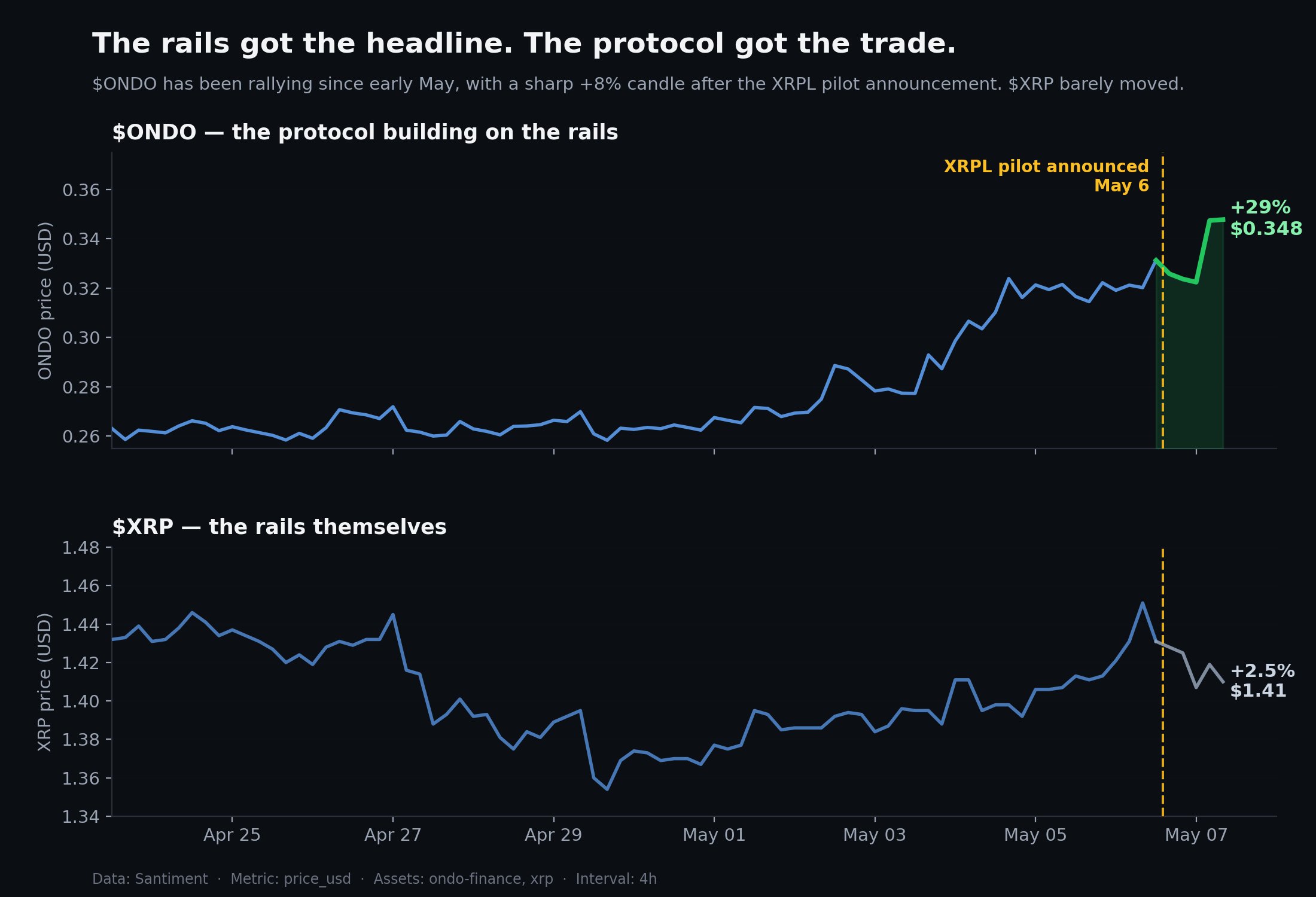
The difference highlights how markets often separate infrastructure from the applications built on top of it.
In this case, the $XRP Ledger acted as the settlement rail, providing the speed and low-cost execution required for the transaction. However, $ONDO represented the actual tokenized Treasury product at the center of the activity.
As a result, traders focused more heavily on the protocol directly tied to issuance, redemption, and yield exposure rather than on the blockchain that handles the settlement layer beneath.
“The rails got the headline. The protocol got the trade,” Santiment concluded.
Similar Case Between Telegram and TON
This structure mirrors what happened within the Telegram and TON ecosystem. Telegram drove mainstream attention through its massive user base and crypto integrations. Yet, much of the market value flowed toward Toncoin and projects operating directly within that network.
Most recently, Telegram founder Pavel Durov announced that Telegram has replaced the TON Foundation as TON’s largest validator. The coin has since doubled, growing 90% in the past seven days to $2.48.
This event draws the conclusion that the infrastructure created access, but the ecosystem assets captured stronger speculation and capital inflows. The same dynamic now appears within institutional tokenization.
XRPL Validates Institutional Utility Despite Limited $XRP Reaction
Importantly, the muted $XRP response does not necessarily diminish the pilot program’s significance. The event demonstrated that the $XRP Ledger can support institutional-grade settlement for tokenized real-world assets in near real time.
That matters because tokenized Treasuries continue gaining traction across financial markets. Faster settlement, continuous market access, and lower operational friction remain key themes for institutions exploring blockchain infrastructure.
Still, markets often reward the protocols tied directly to revenue generation, asset issuance, or user demand rather than the underlying rails themselves. $ONDO benefited because its ecosystem sits closer to the economic activity surrounding tokenized Treasury exposure.
Meanwhile, the $XRP Ledger functioned more as the enabling layer behind the scenes. Although the blockchain received the headline visibility, the stronger market reaction flowed toward the asset associated with the product itself. Still, industry leaders claim that $XRP is the cleanest way of investing in tokenization
Moreover, the move emphasizes the growing use case for tokenization in the crypto industry. Data shows that $31.12 billion in real-world assets have been tokenized on blockchains, highlighting the steady adoption of blockchain rails to bring tangible assets on-chain.

 coindesk.com
 coingape.com
 thedefiant.io