


 23
23
A new debate is building in the latest $XRP news. Many users fear that Ripple’s stablecoin push could weaken $XRP’s role. But new research suggests the opposite. $RLUSD is not here to replace $XRP. Instead, it may make the $XRP Ledger more practical for real-world use. At the center of this discussion is Ripple’s evolving strategy. The firm is now building a multi-asset system. In this system, each component plays a different role. $RLUSD handles stable value. $XRP supports liquidity and network functions. Meanwhile, the XRPL acts as the settlement layer.
$RLUSD and $XRP Serve Different Roles
The simplest way to understand this is role separation. $RLUSD is designed to provide a stable dollar value. This makes it useful for payments, trading, and treasury management. Businesses often need price stability. They cannot risk holding volatile assets for daily operations.
🚨 Research: $RLUSD Does Not Replace $XRP. It Makes the $XRP Ledger More Useful.
— RippleXity (@RippleXity) May 1, 2026
$RLUSD = stable dollar value
$XRP = native liquidity + fees + bridge asset#XRPL = settlement rail
Different jobs. One stronger stack. pic.twitter.com/hUniKJKFgN
On the other hand, $XRP plays a completely different role. It is the native asset of the $XRP Ledger. This powers transaction fees and account reserves. It also acts as a bridge asset for liquidity across the network. As one analysis explains, “Stable value, native liquidity, and settlement are different jobs.” This means $RLUSD and $XRP are not competing. They are working together. $RLUSD reduces volatility exposure. $XRP enables movement, routing, and efficiency.
Why Stablecoins Alone Are Not Enough
Stablecoins solve one key problem: price volatility. However, they do not solve liquidity on their own. A stablecoin still needs markets, exchanges, and routing systems to move between assets. This is where $XRP becomes important. The XRPL includes built-in features like a decentralized exchange, automated market makers, and cross-currency payment paths. These tools allow assets to interact smoothly.
In many cases, $XRP can act as a bridge between two assets. It helps find the most efficient route for a transaction. This process is known as auto bridging. It allows payments to settle faster and often at lower cost. So, while $RLUSD offers stability, $XRP ensures movement. Together, they create a more complete system.
$XRP’s Core Functions Remain Strong
Despite the rise of $RLUSD, $XRP still performs key roles that stablecoins cannot replace. First, it supports network security. Every transaction on the XRPL burns a small amount of $XRP as a fee. This prevents spam and protects the system. Second, $XRP allows direct settlement. If both parties accept $XRP, funds can move instantly without relying on any issuer. This creates a different risk profile compared to stablecoins.
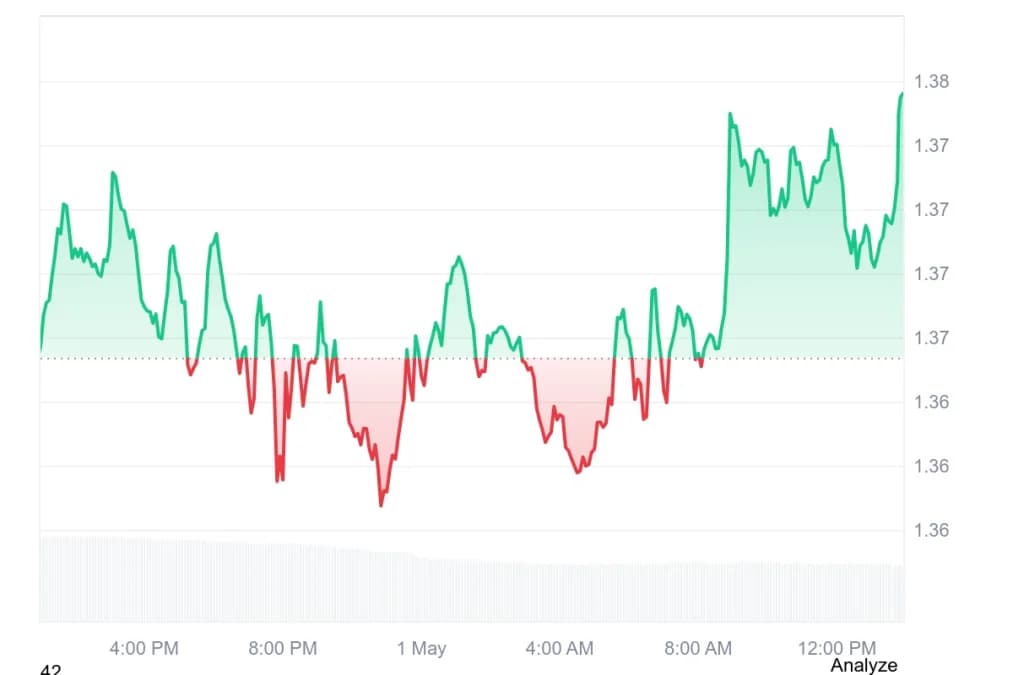
Chart- $XRP price on 1 May, 2026, by CoinMarketCap
Third, $XRP plays a major role in liquidity routing. It can connect different assets within the XRPL ecosystem. This makes it valuable even if it is not the final asset in a transaction. At the time of writing, the $XRP current price USD stands near $1.37. While price movements continue, its utility inside the network remains unchanged.
A Stronger Stack, Not a Replacement
The bigger picture is clear. Ripple is not choosing between $RLUSD and $XRP. It is building a layered financial system. Each layer solves a different problem. $RLUSD brings stable value for institutions. $XRP provides liquidity and network efficiency. The XRPL connects everything through fast and low-cost settlement. This approach reflects a broader shift in crypto.
Projects are moving beyond single-asset models. Instead, they are creating full ecosystems that can support real-world finance. In this context, $XRP news is no longer about survival. It is about evolution. $RLUSD does not weaken $XRP. It gives the $XRP Ledger more ways to be used. Furthermore, in a market driven by utility, that could matter more than anything else.

 coindesk.com
 u.today