


 3
3
Tron Inc. (TRON) has crossed 686 million $TRX tokens in its corporate treasury after months of daily purchases, fueling comparisons to MicroStrategy’s Bitcoin accumulation model.
The Nasdaq-listed company, which transformed from toy manufacturer SRM Entertainment through a mid-2025 reverse merger, now sits at the center of a coordinated narrative campaign led by Justin Sun and crypto influencers.
Tron Moves From Toy Maker to Token Treasury
SRM Entertainment, a Florida-based supplier of theme park merchandise, rebranded as Tron Inc. in July 2025 after receiving a $100 million equity injection paid in $TRX tokens.
Sun joined as a strategic advisor, with the deal, facilitated by Dominari Securities, valuing the full package at up to $210 million including warrants.
Since the rebrand, Tron Inc. has followed a rigid accumulation plan. The company purchases roughly $50,000 in $TRX daily, targeting 360 consecutive days.
As of March 16, 2026, total holdings stood at approximately 686.8 million $TRX, worth roughly $206 million at current prices near $0.30.
Tron Inc. (NASDAQ: TRON) acquired 168,783 $TRX tokens today at an average price of $0.2962, further increasing its $TRX treasury holdings to more than 686.7 million $TRX in total. The company aims to further grow its Tron DAT holdings to enhance long term shareholder value. For live…
— Tron Inc. (@TRON_INC) March 15, 2026
In December 2025, Sun injected an additional $18 million through an equity investment via Black Anthem Limited, acquiring restricted common stock at $1.3775 per share.
The company has described these moves as efforts to become the largest publicly traded holder of $TRX.
 $TRX) Stock Performance. ">
“Building the largest $TRX treasury in the public markets is not symbolic; it is strategic. We are executing a deliberate accumulation strategy that reflects our confidence in TRON’s scalability, real-world utility, and long-term value creation,” said CEO Rich Miller in a February 2026 press release.
Sun’s Circle Comparison and the $3.3 Billion Claim
In a recent post, Tron founder Justin Sun said that Wall Street had been asking about a cheaper, more profitable alternative to Circle Internet Group (CRCL), the issuer of USDC. He pointed to Tron Inc. as the answer.
“Wall Street has been asking lately: What is the Chinese version of CRCL? Because they want to invest in a “CRCL” that is more efficient, lower-valued, and more profitable. The answer is here now: TRON,” wrote Sun.
His argument rested on three points:
- The TRON blockchain processes stablecoin issuance at a scale comparable to Circle.
- The network generated $3.3 billion in protocol-level profit over the past year.
- Tron Inc. trades at roughly one-seventieth of Circle’s market capitalization, which currently stands at roughly $35.12 billion.
The profitability claim requires careful context.
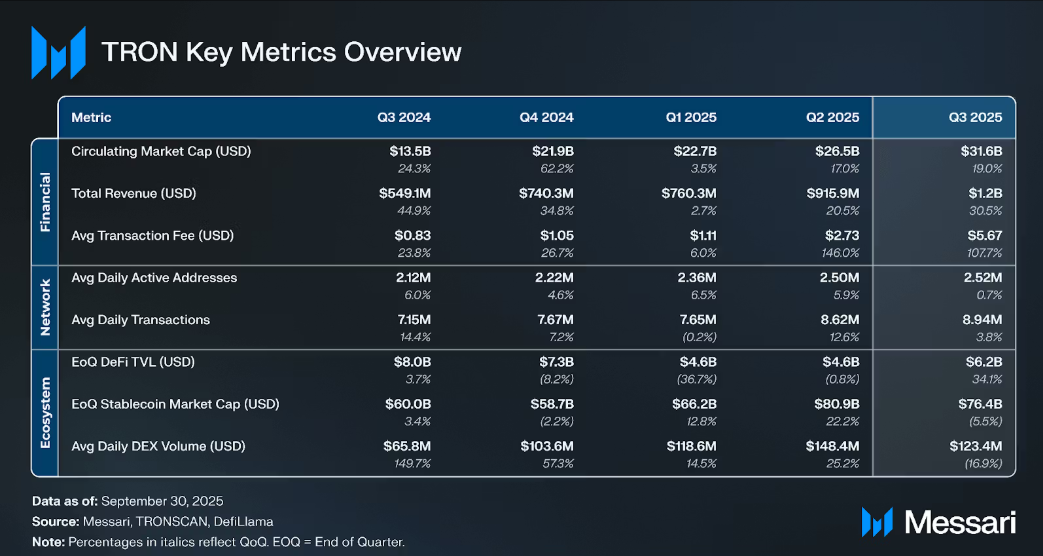
TRON protocol revenue, driven primarily by USDT transfer fees, reached $1.2 billion in Q3 2025 alone, according to a Messari research report.
Meanwhile, a Kaiko analysis from March 2026 found that TRON was the only major Layer-1 blockchain turning a net profit after accounting for token inflation costs.
These are network-level metrics, however, not earnings of Tron Inc. the publicly traded entity.
Circle, for its part, posted a full-year 2025 net loss of $70 million. That figure was heavily impacted by $424 million in non-cash stock-based compensation tied to its June 2025 IPO.
The company earned $133 million in Q4 2025 net income on $770 million in revenue. Adjusted EBITDA for the quarter grew 412% year over year.
Comparing TRON network fee revenue to Circle’s corporate earnings conflates two fundamentally different measurements. Tron Inc. holds $TRX tokens on its balance sheet but does not directly capture the protocol’s transaction fee stream.
The MicroStrategy Parallel and Its Limits
May, a crypto KOL, amplified the narrative by drawing a direct line between Tron Inc. and Strategy, formerly MicroStrategy. The KOL noted that Strategy’s market cap was approximately $1.2 billion when it first purchased Bitcoin in August 2020, and that it grew roughly 100-fold over five years.
Tron Inc., at around $400 to $500 million, starts from an even smaller base.
“History is always repeating itself! TRON Inc. is recreating MSTR’s growth legend,” wrote May.
The analogy has structural appeal.
- Both companies use public equity markets to accumulate a native digital asset.
- Both rely on treasury value as their primary investment thesis.
- Both founders maintain outsized public influence over both the asset and the company.
However, key differences complicate the comparison.
- Strategy accumulated Bitcoin, an asset with broad institutional demand, deep liquidity, and no single controlling entity.
- Tron Inc. accumulates $TRX, a token created by the same individual who advises the company.
- Justin Sun founded the TRON blockchain, chairs its foundation, and maintains influence over Tron Inc. through a layered network of affiliated entities.
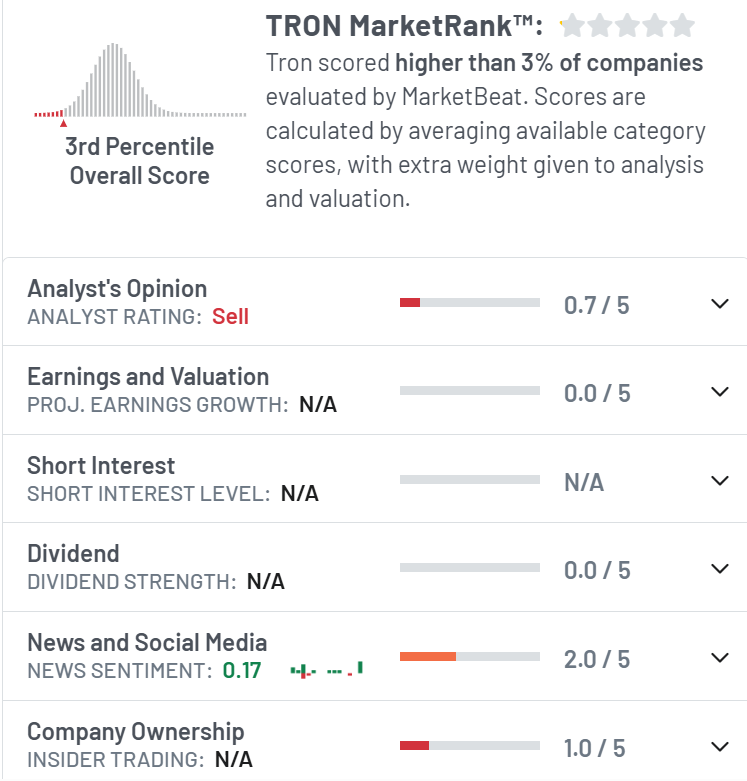
That overlap has drawn scrutiny. Weiss Ratings issued a “sell” rating on Tron Inc. stock in December 2025. The stock carries a beta of 13.83 and a negative price-to-earnings ratio.
Only one analyst covers the name, with a consensus sell recommendation, meaning the “consensus” is just one firm’s opinion presented in MarketBeat’s standard consensus format.
Additionally, the SEC reached a settlement with Rainberry Inc., a TRON-affiliated entity, in March 2026.
I am very pleased to confirm that the SEC has moved to dismiss all claims against me, Tron Foundation, and BitTorrent Foundation.
— H.E. Justin Sun 👨🚀 🌞 (@justinsuntron) March 5, 2026
Today’s resolution brings closure, but I never stopped building. I will continue to focus on accelerating innovation in the United States and around…
Rainberry agreed to pay $10 million and accepted a bar on future securities violations, resolving allegations of unregistered token sales and wash trading stemming from a 2023 lawsuit.
What the Market Is Pricing
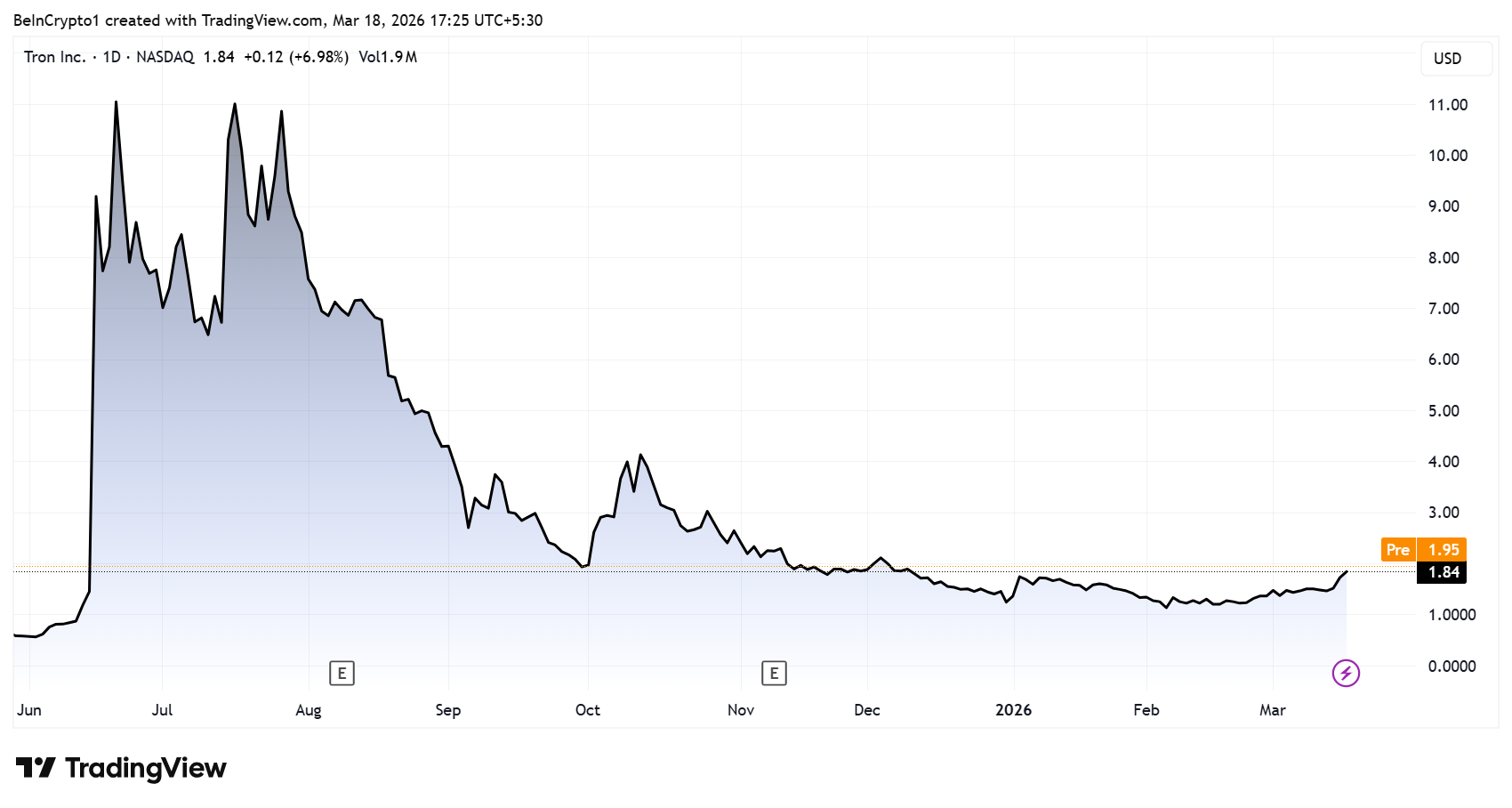
Tron Inc. stock traded near $1.84 as of this writing, giving it a market capitalization of roughly $517 million. That represents a steep decline from its all-time high of $12.80 in July 2025, shortly after the reverse merger.
The company’s $TRX holdings are worth approximately $206 million, meaning the stock trades at a premium to its net asset value.
Whether that premium reflects confidence in the accumulation strategy or speculative momentum remains an open question.
If the playbook succeeds, it could establish a new template for Layer-1 ecosystems seeking public market exposure.
If it falters, it will serve as an example of the risks of concentrated token treasury strategies built around a single founder’s influence.
The post Justin Sun Pitches TRON Inc as Cheaper Circle With MicroStrategy Model appeared first on BeInCrypto.

 crypto-economy.com

 coinpedia.org
 u.today
 crypto-news-flash.com