



 16
16
Table of Contents
Silverscript is a high-level smart contract language and compiler built for the Kaspa blockchain. Announced on February 10, 2026, by developer Ori Newman, it introduces programmable features directly on Kaspa’s Layer 1 (L1) without relying on external virtual machines or shared global state models such as Ethereum’s EVM.
Silverscript compiles into native Kaspa Script and is designed for Kaspa’s UTXO-based architecture. It enables developers to write readable covenant logic that enforces transaction rules at the protocol level.
What Problem Does Silverscript Solve on Kaspa?
Kaspa is a Proof-of-Work (PoW) cryptocurrency built on a BlockDAG (Directed Acyclic Graph) structure. Unlike linear blockchains, Kaspa processes blocks in parallel. The network currently targets 10 blocks per second, with upgrades such as DAGKnight aiming for 100+ blocks per second.
Until now, Kaspa scripting has been limited in expressiveness. Silverscript addresses this by introducing structured programming features that allow more advanced covenant design while remaining aligned with the UTXO model.
Instead of a shared global state, common in account-based systems, Silverscript maintains a local state per UTXO. This reduces risks such as reentrancy vulnerabilities found in EVM-based systems.
How Does Silverscript Work?
Silverscript is inspired by CashScript, a smart contract language used in Bitcoin Cash. However, it expands on CashScript by adding structured programming tools required for more complex DeFi primitives.
It compiles high-level code into low-level Kaspa opcodes, including:
- KIP-10 (introspection opcodes)
- KIP-16 (zero-knowledge verification opcodes)
- KIP-17 (byte primitives)
It is designed to integrate with upcoming network upgrades scheduled for May 5, 2026, which introduce:
- Covenants++ (advanced spending constraints)
- Native assets under KIP-20 (token lineage and provenance tracking)
- Zero-knowledge (ZK) verification support
Silverscript acts as a development layer for these protocol features.
What Features Does Silverscript Add to Kaspa?
Silverscript introduces structured programming elements that were previously unavailable in Kaspa Script.
Loops
Supports iterative operations such as for loops.
This allows repeated calculations, batch processing, and conditional asset logic.
Arrays
Supports dynamic data structures.
Developers can manage token balances, multi-signature conditions, or structured outputs.
Function Calls
Allows reusable functions with parameters and return values.
Improves code clarity and reduces implementation errors.
Require Statements
Provides built-in assertions.
Contracts can enforce constraints such as array size limits or value checks at compile time or runtime.
UTXO-Focused Design
Operates on local UTXO state rather than shared global state.
This model enforces explicit validation and avoids reentrancy issues.
What Does Silverscript Code Look Like?
Silverscript uses a simplified C-like syntax. The following example demonstrates arrays, loops, and require statements:
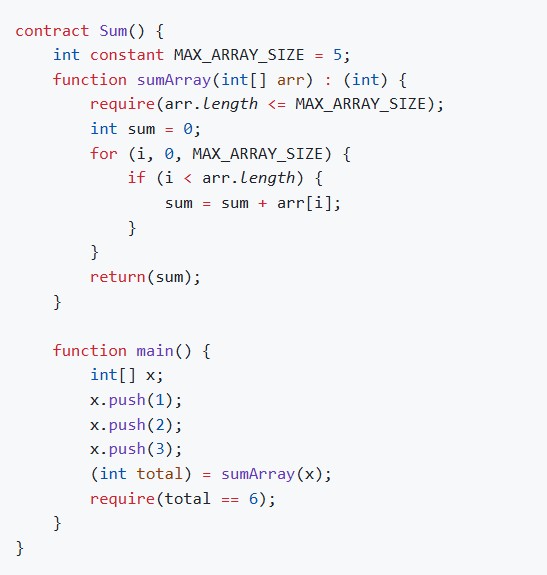
This example defines a function that sums the elements of an integer array. It checks the array length, iterates over the elements, and ensures the sum equals 6.
In production use, similar logic could apply to:
- Token distribution enforcement
- Vault withdrawal conditions
- Escrow validation rules
- Structured DeFi outputs
The syntax is experimental and currently available only on Testnet-12.
How Is Silverscript Different From CashScript?
Silverscript builds on CashScript but extends its capabilities.
Similarities:
- High-level syntax for UTXO-based covenants
- Focus on transaction constraints rather than full Turing completeness
Differences:
- Native support for loops
- Native arrays
- Function definitions and modular structure
- Designed specifically for Kaspa’s BlockDAG
CashScript does not provide built-in support for structured loops or dynamic arrays. Silverscript introduces these features to support more expressive covenant logic.
How Does Silverscript Fit Into Kaspa’s Ecosystem?
Silverscript operates within a broader architecture that separates local and shared state models:
- Local state: Managed by Silverscript via UTXO covenants
- Shared computation: Managed by vProgs (Verifiable Programs), verified on-chain using zero-knowledge proofs
It integrates with:
- KIP-20 native asset support (token provenance enforcement)
- CDAG (Computational DAG) for program dependencies
- Sparkle, a ZK-based rollup framework
This structure enables:
- Automated market makers (AMMs) using enforced output structures
- Lending vaults
- Atomic swaps
- DAO governance encoded in scripts
All without mutable global state.
What Is the Current Development Status?
Silverscript is experimental and compatible only with Kaspa Testnet-12. It is not yet available on the mainnet.
The GitHub repository includes:
- Compiler implementation
- Examples
- TUTORIAL.md documentation
Developer Ori Newman, active in Bitcoin since 2013, maintains the project and has indicated potential support for WebAssembly (WASM) in the future.
Mainnet compatibility depends on the May 5, 2026, hardfork that activates Covenants++ and native asset functionality.
Conclusion
Silverscript introduces structured smart contract development to Kaspa’s UTXO-based BlockDAG network. It adds loops, arrays, functions, and enforceable assertions while compiling to native opcodes. The language aligns with upcoming protocol upgrades, including Covenants++, native assets, and zero-knowledge verification.
Currently limited to Testnet-12, Silverscript provides the technical foundation for programmable Layer 1 applications on Kaspa without adopting shared global state models.
Sources:
- Kaspa GitHub Repository: Silverscript Language tutorial
- X Post: Public announcement by Ori Newman

 thecryptobasic.com
 1
1

 neonewstoday.com
 coinfomania.com