

 1
1

 18
18
Table of Contents
Spacecoin is a decentralized physical infrastructure network (DePIN) project building satellite-powered internet on blockchain. The project uses low-Earth orbit (LEO) satellites to deliver permissionless connectivity to regions where traditional broadband coverage is limited. Its January 2026 partnership with World Liberty Financial ($WLFI) brings together space tech and DeFi in an unusual pairing.
The collaboration centers on a strategic token swap and integrates $WLFI's $USD1 stablecoin into Spacecoin's network. For crypto observers tracking real-world utility plays, this partnership raises questions about whether satellite-based infrastructure can actually deliver on its global connectivity promises.
How Does Spacecoin Work?
Spacecoin combines satellite technology with blockchain to create what it calls a trustless internet layer. The network targets unbanked populations in remote areas, conflict zones, and regions facing geopolitical restrictions on internet access. Think parts of Iran, Russia, or developing nations where traditional infrastructure simply doesn't reach.
The project hit key milestones before its token launch. In December 2024, Spacecoin launched $CTC-0, which routed the world's first end-to-end blockchain transaction through space. $CTC-1 followed in November 2025, demonstrating stable satellite connections and inter-satellite data exchange.
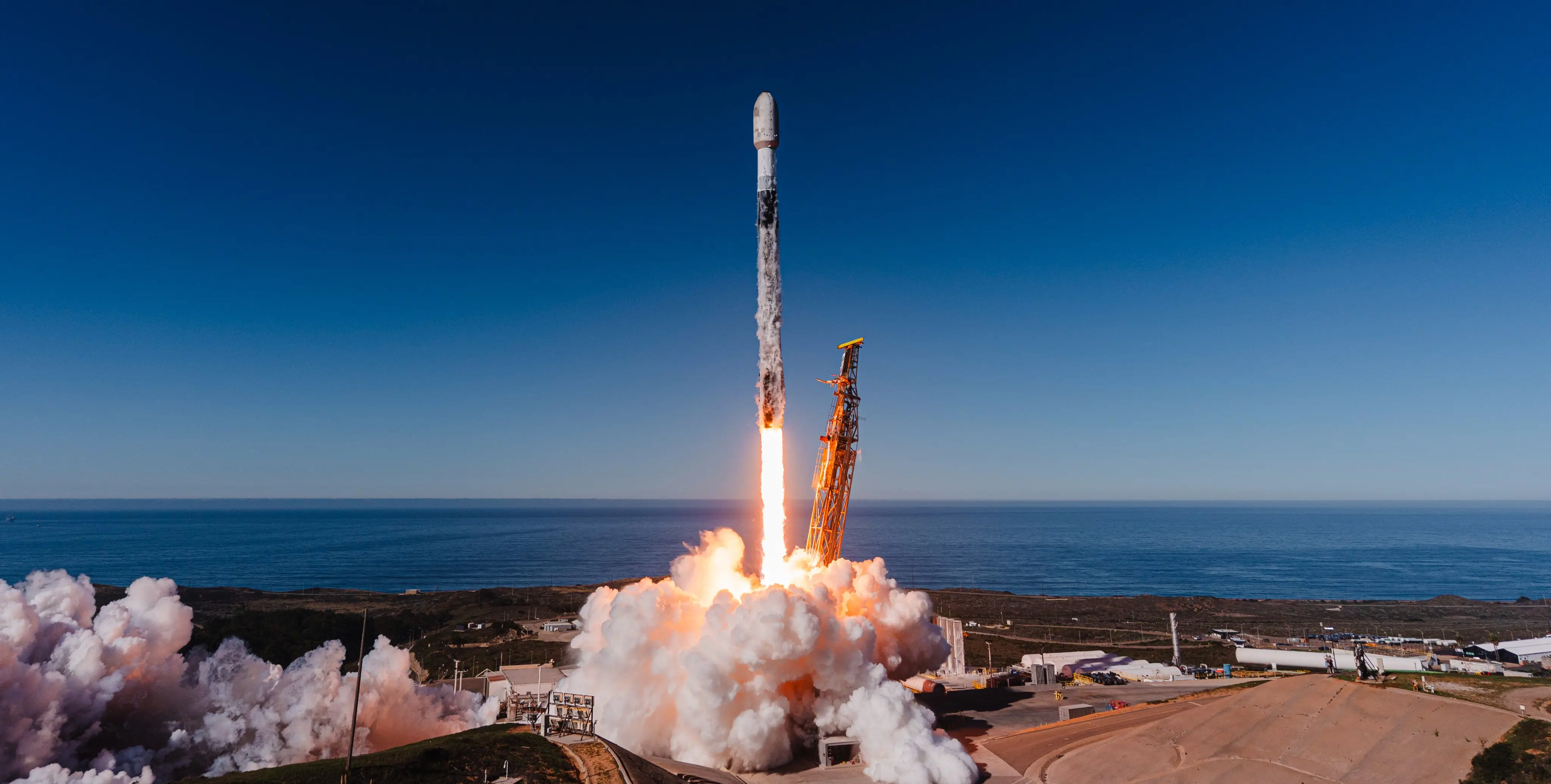 $CTC-1 satelite launch by SpaceX Falcon-9">
The tech stack includes partnerships with Creditcoin for cross-chain financial services, Sui Network for scalable computation, and Walrus Protocol for decentralized storage. Together, these integrations aim to deliver 5G-equivalent speeds in hard-to-reach areas while maintaining privacy-focused data transmission.
What is the $SPACE Token?
The native $SPACE token went live in January 2026 following its token generation event (TGE). It serves four primary functions: funding infrastructure development, enabling staking for network security, facilitating governance decisions, and allowing users to pay for satellite internet services.
Total supply sits at 21 billion tokens, a nod to Bitcoin's scarcity model, scaled for utility. The token has secured listings on Bitget, Kucoin, Kraken, and Binance Alpha.
Why Did $WLFI Partner With Spacecoin?
World Liberty Financial, the Trump family-linked DeFi project, announced the Spacecoin partnership in January 2026. $WLFI's $USD1 stablecoin carries a market cap exceeding $3.2 billion, giving it significant weight in the stablecoin sector.
The logic is straightforward: complementary strengths. $WLFI brings a regulated, dollar-backed stablecoin and established DeFi infrastructure. Spacecoin contributes its satellite network. Combined, they aim to deliver financial services to populations without reliable internet or banking access.
Under this arrangement, $USD1 becomes a primary payment method within Spacecoin's network. Users in remote regions could theoretically access satellite connectivity to use $USD1 for payments, lending, or staking. This bypasses local currency volatility and the infrastructure limitations that typically exclude these populations from DeFi.
$SPACE became the first token to launch with a $USD1 trading pair on Binance Alpha. For $WLFI, the partnership extends $USD1's utility into emerging sectors. For Spacecoin, it provides stable funding channels and a clearer path to user onboarding.
What Are the Risks?
The partnership hasn't escaped criticism. Some community members on X have flagged concerns about price volatility post-launch, with a few labeling it a potential rug pull. These concerns reflect broader skepticism that often follows high-profile announcements in crypto.
$WLFI's political associations add another layer of complexity. The Trump family connection invites scrutiny that purely tech-focused projects avoid. Whether that attention helps or hurts adoption remains unclear.
On the technical side, Spacecoin faces the same challenges as any space infrastructure project: regulatory hurdles across multiple jurisdictions, scalability questions, and the sheer difficulty of deploying and maintaining satellite constellations. Crypto-native doesn't solve physics.
What Comes Next?
Spacecoin plans additional satellite launches throughout 2026, working toward full constellation deployment. The $WLFI partnership could accelerate this timeline by providing stable capital flows and broader user access through $USD1 integration.
The project fits a growing trend toward real-world utility in crypto. DePIN has emerged as one of the few sectors demonstrating tangible use cases beyond speculation. Whether Spacecoin can execute on its roadmap will determine if this partnership amounts to substance or just another announcement cycle.
For now, the combination of satellite infrastructure and stablecoin payments sets up a real test for crypto's ability to serve populations that traditional finance has left behind.
Learn more at spacecoin.org or follow @spacecoin on X.
Sources
- Spacecoin Medium - Official partnership announcement with founder quotes
- Spacecoin Medium - $CTC-0 and $CTC-1 satellite mission details
- CoinMarketCap - Token supply data and market information
- Coinspeaker via Yahoo Finance - First $USD1 trading pair on Binance Alpha confirmation

 thecryptobasic.com
 coinpedia.org

 cryptobriefing.com
 cryptopolitan.com